Exchange Settlement Prices Missing or Wrong: ICE and CME/NYMEX Settles
Last updated: July 1, 2026
When an exchange settle doesn't arrive, your cleared positions quietly mark to yesterday's price — the report still runs, the valuations still populate, and the numbers are simply wrong on exactly the positions that matter most at end of day. It's silent, but it's fast to catch: a quick mark-source check tells you whether a position is marked to today's official settle or to a stale carried-forward price, and if a settle is missing you can drop in a temporary mark and value correctly overnight. This article covers what's specific to exchange settles (ICE settle files and CME/NYMEX final settlements), including the normal preliminary-to-final progression that often gets reported as a bug.
This is about the price, not the trade. Your exchange trade is in Molecule; the official settlement price that should mark it is missing, stale, or wrong. If the trade itself is missing, that's a different problem — see "A Trade Is Missing From Molecule: Troubleshooting Exchange Trade Feeds." The reason they're different is the next section.
Trade feed and settle-price feed are separate
Molecule receives exchange-cleared trades and exchange settlement prices through two different feeds:
Trades flow in through a trade adapter using STP (straight-through processing) — your fills move from the exchange or clearing venue into Molecule as trades.
Settlement prices arrive separately as market-data marks from automated settlement files — ICE settle files and CME/NYMEX settlement files. (A settle is the exchange's official end-of-day settlement price; a mark is the price used to value a position on a date.)
Because these are two independent feeds, they fail independently: your ICE or CME trade can be present and correct while the settlement price is missing — so the position marks to a stale price — or a settle price can be present while a trade is missing.
The practical payoff is routing. When a position isn't marked to today's settle, it's almost always a settle-price (market-data) issue, not a trade-feed issue. Escalate it as a missing or stale settlement mark — naming the product and date — not as a missing trade. Getting that distinction right is the single most useful thing this article does, because it sends the problem to the right place the first time. (For the trade-capture side, see "ICE + CME Adapters.")
Preliminary vs. final settles — the normal daily progression
A settle value that changes between the trading session and the close is usually not a bug — it's the normal progression from a preliminary to a final settlement. For CME/NYMEX:
During or after the session, an intraday preliminary settlement can arrive. In Molecule this is a mark with curve source
prelim(a prelim is a preliminary settlement, expected to be replaced).At end of day, the final post-clearing settlement file arrives as a mark with curve source
vendor, and it automatically replaces the preliminary for that product, contract period, and date in valuations.
So a CME settle that updates between the session and EOD is the preliminary being displaced by the final — working as designed.
ICE is different. ICE settle files always produce final marks (curve source vendor); there is no separate preliminary stage for ICE the way there is for CME/NYMEX. That's why a CME settle may move during the day while your ICE settle doesn't.
How to tell what you're looking at
Every mark has a source — internally its curve source, shown in the API and in support conversations as values like vendor or copy. You don't read those raw values off a "curve source" column on the Curves screen, though — there isn't one. The customer-facing UI surfaces the source in two places:
On the Curves screen (Market Data → Curves) — through a mark-source filter, the small funnel control at the top of the Product column. It switches the view between sources, each shown with a plain-language label (the technical curve source is in parentheses):
Settles (Automatic) (
vendor) — the official final settlement (ICE settle or CME/NYMEX final). This is what you normally want overnight.Prelims (Automatic) (
prelim) — a preliminary CME/NYMEX settlement, expected to be replaced by the final.Copied from Prior Day (
copy) and Substituted Prelims (Automatic) (prelim_copy) — a mark carried forward because no new settle arrived: a stale settle. If you see either on a day the exchange did settle, the settlement price didn't land.Best Available (Default) — the single highest-priority mark Molecule is actually using to value each product.
On a trade's Valuations table — as the Mark Level and Prior Mark Level columns. These show the raw curve-source value (vendor, copy, prelim_copy, and so on) that valued the position on that date and the day before — so a valuation row tells you directly whether it settled against the official settle or a carried-forward price.
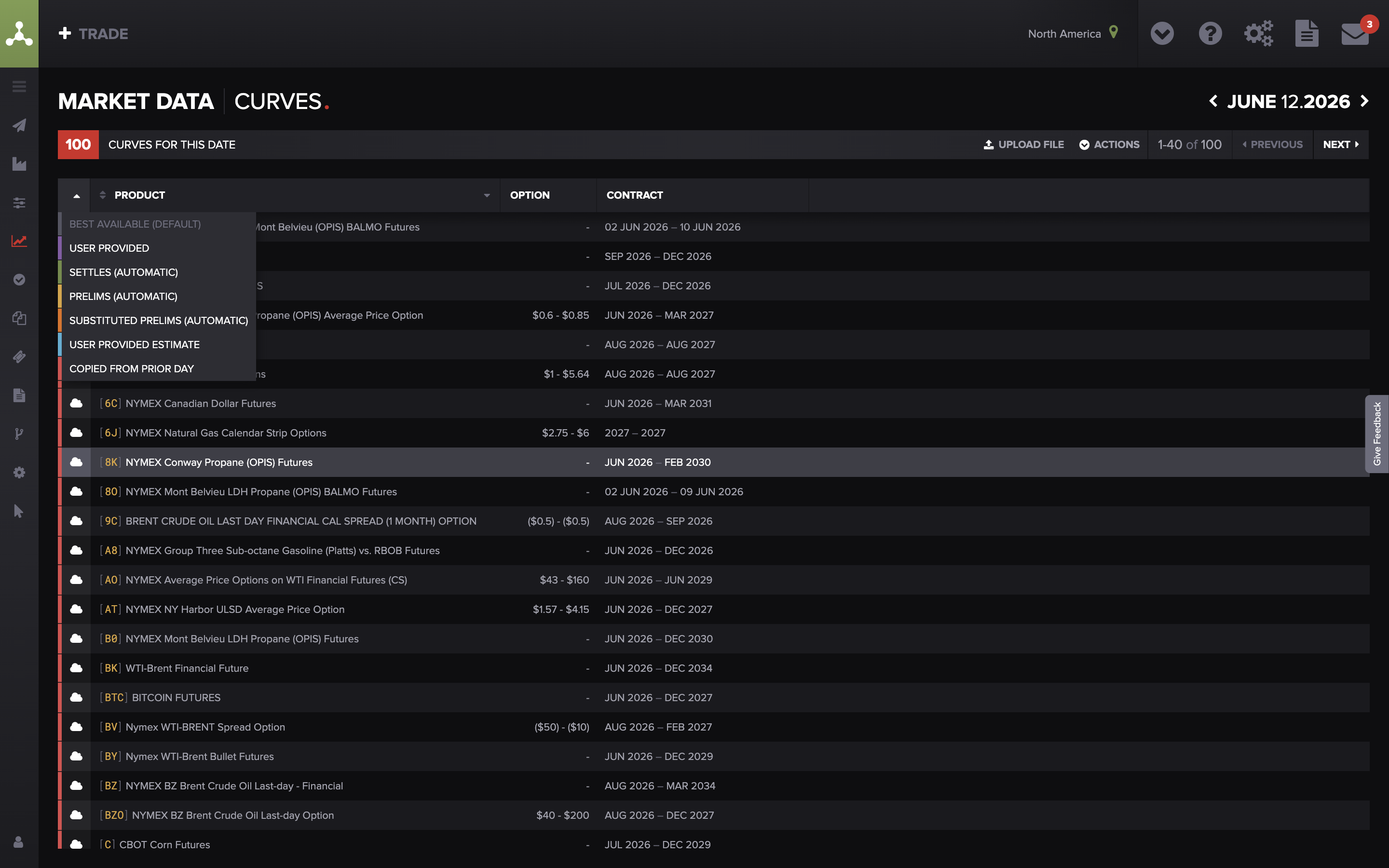
The mark-source filter on the Curves screen. The funnel at the top of the Product column (Market Data → Curves) opens this filter. Switch to Settles (Automatic) or Copied from Prior Day to see whether today's price is a fresh settle or a carried-forward copy; Best Available (Default) is the value actually being used. Alt text: Molecule Curves screen with the mark-source filter open, showing the plain-language source options.
Marks are prioritized for valuation, highest to lowest: user → vendor → prelim → prelim_copy → user_estimate → copy. So a final (vendor) settle automatically wins over a preliminary or a carried-forward copy as soon as it arrives — many "stale" settles resolve themselves once the final lands.
Molecule also records the source used for the current and prior valuation on each settlement entry — shown on a trade's Valuations table as its Mark Level and Prior Mark Level (the curve source and prior curve source) — so you can audit exactly which price marked a position on a given day. See "Mark Levels" for the full curve-source definitions and "Valuation Outputs" for the settlement-entry fields.
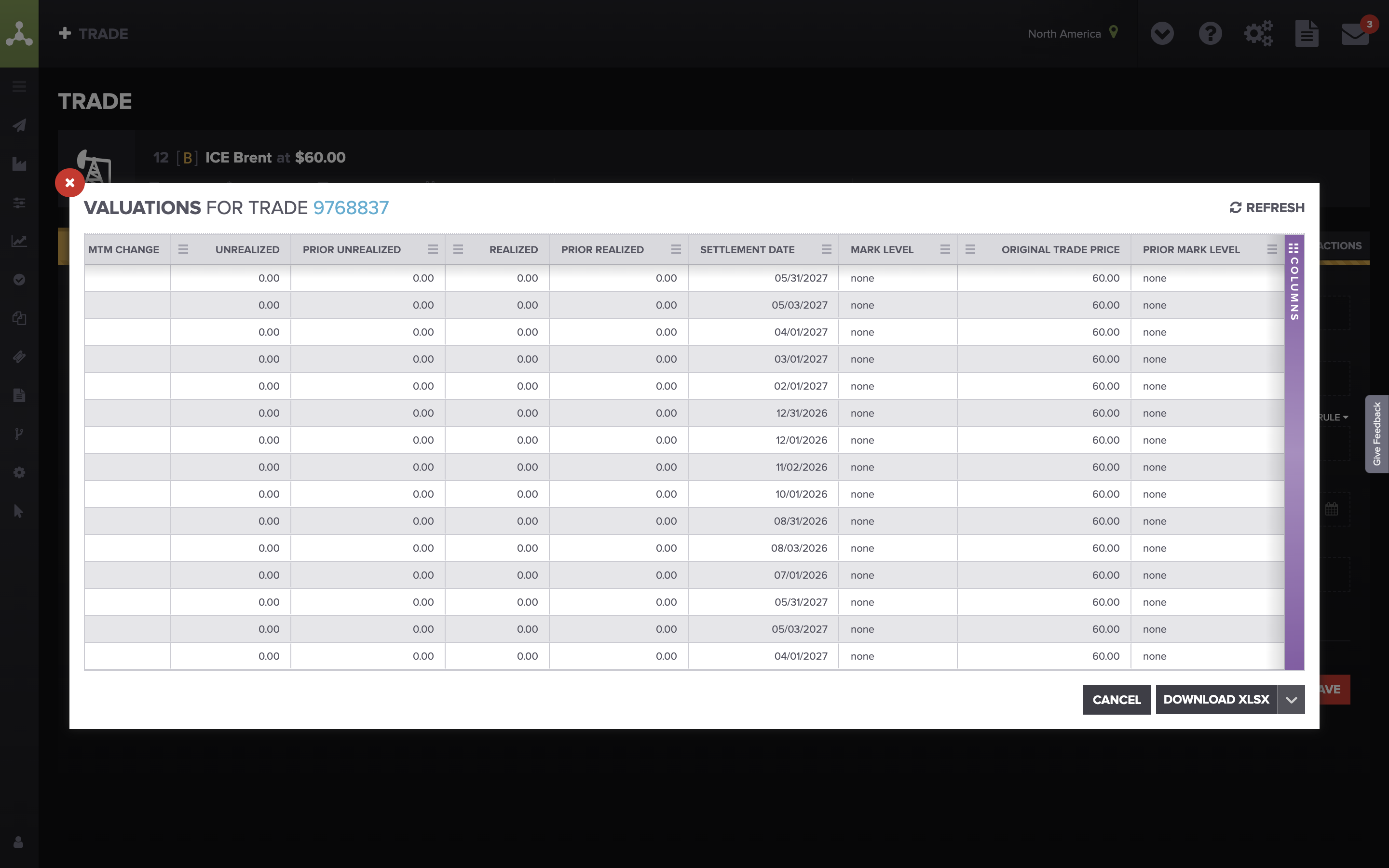
SThe Mark Level column on a trade's valuation rows.
Each valuation row records the source that valued it in the Mark Level column (and the prior day's in Prior Mark Level), so you can confirm a position valued against the official settle (vendor) rather than a carried-forward price (copy/prelim_copy). Alt text: A Molecule trade Valuations table showing the Mark Level and Prior Mark Level columns.
Overnight is the high-stakes case. When an exchange settles but its settlement marks aren't received, open positions held overnight are valued against stale prior-day prices instead of the fresh settlement — and it's silent. Molecule doesn't surface a feed-status view to customers, so this mark-source spot-check is how you catch it: after a settlement day, confirm your key exchange positions show Settles (Automatic) (vendor) for that date — not Copied from Prior Day or Substituted Prelims (copy/prelim_copy), especially before relying on an overnight risk or P&L number.
Fix it now: a temporary mark
If a settle is missing or stale and you need correct overnight valuations immediately, upload your own mark as a temporary override. A normally uploaded mark is saved as User Provided (curve source user), the highest priority, so it overrides the stale or copied settle right away. For the step-by-step upload, see "How to Import Market Data Curves"; for the full procedure and the mark-source self-check in depth, see the companion article "My Prices Look Stale or Missing: Troubleshooting Vendor Market-Data Feeds."
Remove it once the real settle is flowing again. Because user outranks vendor, your manual mark will keep overriding the official settle even after the feed is restored — so it's a temporary patch, not set-and-forget. To hand pricing back to the exchange settle, remove your manual mark; Molecule retains the official settle underneath and re-selects it automatically.
Diagnose it by symptom
My position marked to yesterday's price after a settlement day. Check the mark source — on the Curves screen, filter to Settles (Automatic) to see whether today's settle exists; Copied from Prior Day or Substituted Prelims (copy/prelim_copy) means the settle didn't land (stale). Rule out timing — final settles arrive after the close, so a price that hasn't updated mid-evening may simply not have published yet. If you need the number now, apply a temporary mark (above); if it should have arrived and hasn't, escalate it as a missing settle (below).
My CME settle price changed between the session and the close. That's almost always the normal preliminary→final progression — the prelim being displaced by the vendor final. Confirm by checking that the current mark's source is now Settles (Automatic) (vendor). Not a bug.
The settle price is present but looks wrong. First rule out the easy explanations: are you comparing a preliminary to a final, the wrong contract or tenor, or a unit mismatch? Check the mark source and confirm the contract period and units match the exchange's published figure. If it's genuinely a wrong value from the settle feed — right contract, right units, not a prelim — escalate, naming the product, contract period, date, the value shown, and the exchange's published value.
When to contact support, and what to include
Missing or wrong exchange settles are repaired by Molecule (re-pulling or repairing the settlement-file feed). You can keep valuing in the meantime with a temporary mark; the escalation is to fix the feed. To make diagnosis fast, include:
Which feed: ICE settle, CME/NYMEX final, or CME/NYMEX preliminary.
The product(s) and contract period(s) affected.
The as-of / settlement date (the as-of is the valuation date).
The mark source you observed — e.g., " Copied from Prior Day (
copy) on 2026-06-10 when ICE settled that day."Whether it's all products on that exchange or just one — this materially speeds diagnosis.
Whether you've applied a temporary mark , so support knows valuations are patched, not broken.
For a "wrong value": the value Molecule shows vs. the exchange's published settle.
On timing: Molecule retries through the day and will repair the feed; ask your support contact for status on a specific settle. [SME VERIFY: there is no published SLA for settle-feed restoration — do not state a timeframe.]
FAQ
My CME settle changed after the close — is that a bug?
Usually not. CME/NYMEX publishes an intraday preliminary settle (prelim) and then a final post-clearing settle (vendor) at end of day, and the final automatically replaces the preliminary. A value that moves from session to close is that hand-off, working as designed.
My ICE position is marked to yesterday — what happened?
The ICE settle for that date probably didn't land, so the position is valued against a carried-forward price. Check the mark source: Copied from Prior Day or Substituted Prelims (copy/prelim_copy) confirms a stale settle. Apply a temporary mark to value correctly now, then escalate the missing settle.
The trade is here but it's not marked to the settle — is the trade feed broken?
No — trades and settle prices arrive on separate feeds. A present trade with a missing mark is a settle-price issue, not a trade-feed one. Escalate it as a missing or stale settlement mark for that product and date.
Can I put in the settle myself until it's fixed?
Yes — upload the correct price as a user mark and it overrides the stale settle immediately. Just remove it once the official settle is flowing again, because a user mark keeps overriding the real settle until you take it out.
Why does a missing settle still show a price instead of an error?
By design — rather than leave a gap, Molecule carries the prior day's mark forward so positions stay valued. That keeps things running but makes a missing settle silent, so the tell isn't an error; it's the mark source (check it with the mark-source filter on the Curves screen, or the Mark Level column on a trade's valuations).
Related articles
Editor: hyperlink each of these to its help.molecule.io article before publishing (URLs to be confirmed once web access is restored).
If you're still stuck after the checklist above, contact support@molecule.io with the details listed in "If none of these explain it."