# Assets Stack
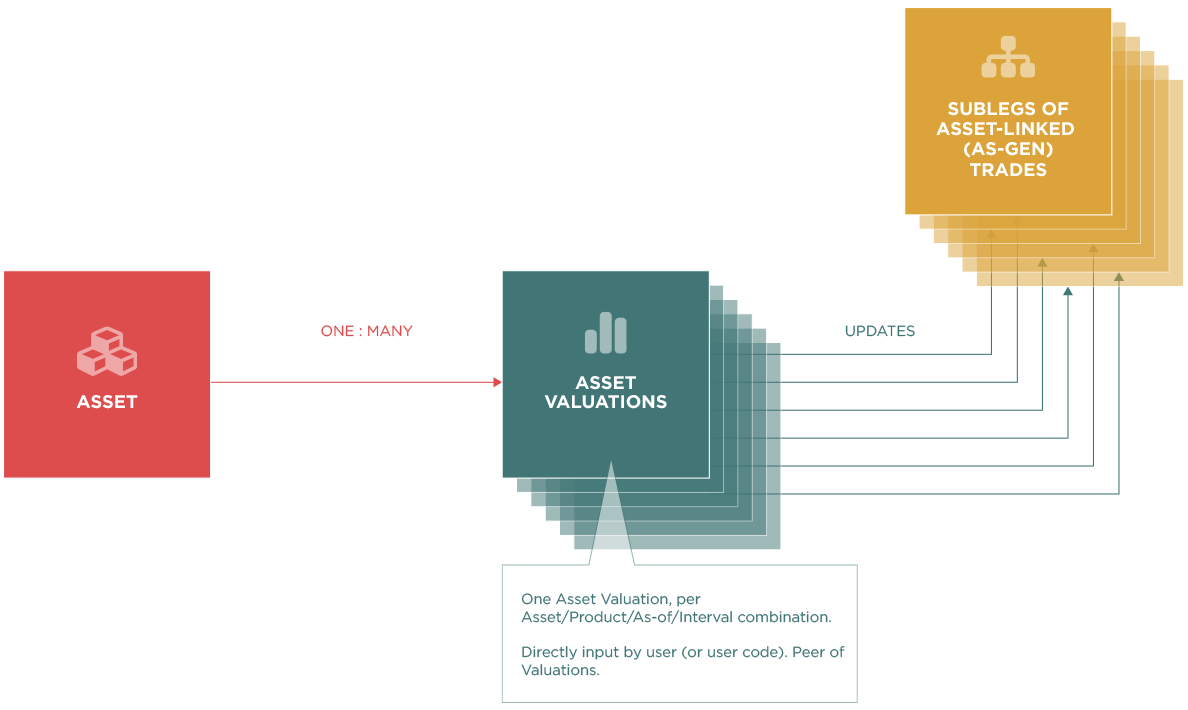
Broadly, Assets provide users the ability to directly write Asset Valuation rows that can line up with Trade Valuation rows. Assets are often used for custom shape, forecasts, natural positions, or even as repositories for the output of custom valuation models.
#### Stack
#### Asset Lifecycle
When an Asset is created, a row is created in the Asset model; nothing else. Users can decide whether child Asset Valuation rows will be created by one of two methods:
1. **Automated Valuation Update**: The Asset can connect to a location (e.g., an external data source) that provides a daily curve of positions, valuations, or other relevant data.
2. **Manual Entry**: Users can upload valuations directly or post data via API.
#### User Interaction
Users interact directly with Asset Valuations — that's what this model is for. It's the place in Molecule where users have the most direct control.
#### Downstream
When Asset Valuation rows are created, they generally do not trigger downstream actions. However, for Assets linked to Trades, updates to Asset Valuations automatically adjust the Trade Subleg volumes. This linkage is particularly useful for:
* **Power Purchase Agreements (PPAs)**: Accurate volume tracking for long-term contracts.
* **Position and Risk Modeling**: Ensuring native positions are included in Value at Risk (VaR) calculations and other risk assessments.
---
# Agent Instructions: Querying This Documentation
If you need additional information that is not directly available in this page, you can query the documentation dynamically by asking a question.
Perform an HTTP GET request on the current page URL with the `ask` query parameter:
```
GET https://help.molecule.io/reference/resources/calculation-and-model-references/assets-stack.md?ask=
```
The question should be specific, self-contained, and written in natural language.
The response will contain a direct answer to the question and relevant excerpts and sources from the documentation.
Use this mechanism when the answer is not explicitly present in the current page, you need clarification or additional context, or you want to retrieve related documentation sections.